STEM Activities for Preschoolers: 20 Easy Hands-On Projects
20 easy STEM activities for preschoolers using everyday materials — from building bridges with blocks to exploring magnets, ramps, and simple machines.
By The Slow Childhood
Our four-year-old spent forty-five minutes last Tuesday watching an ice cube melt on the kitchen counter. She poked it, breathed on it, moved it into a sunny spot, then back into the shade. She put salt on one side and left the other side alone. She did not know she was doing science. She thought she was playing. And that is exactly the point.
STEM — science, technology, engineering, and math — sounds intimidating when applied to preschoolers. But for children ages three to five, STEM is simply what happens when we give them interesting materials and the freedom to ask "what if?" It is building a block tower and watching it fall. It is mixing two colors of water and discovering a third. It is rolling a ball down a ramp and noticing that steeper means faster.
The 20 activities below use everyday materials you likely already have at home. They are organized by STEM area, though preschool activities rarely fit neatly into one category — a child building a marble run is doing engineering, physics, and math all at once.
Why Hands-On STEM Matters for Preschoolers
Young children learn through their senses and actions, not through explanation. Hand a preschooler a bowl of water and a collection of objects with the question "which ones will sink?" and they will remember what they discover for years.
STEM play builds scientific thinking (observing, predicting, testing), problem-solving, persistence, mathematical reasoning, new vocabulary, and the confidence that comes from figuring things out independently. The key is keeping it playful. At the preschool level, STEM is not a subject — it is an orientation toward the world.
Science Activities
1. Sink or Float Experiment
What you need: A large bowl of water, household objects (cork, coin, wooden block, plastic toy, metal spoon, apple, rock, foil ball, leaf)
How to do it: Before testing each item, ask: "Do you think this will sink or float?" Let your child place each object in the water and sort into two groups after testing. This is the scientific method in action — predict, test, observe. For more water-based experiments, our kitchen science experiments for kids has a whole collection.
2. Magnet Exploration
What you need: A magnet kit for kids (horseshoe, bar, and wand magnets), items to test (paper clips, coins, buttons, foil, keys, wooden blocks, plastic toys, bolts)
How to do it: Let your child explore freely for ten to fifteen minutes, then introduce the object collection and sort into "magnetic" and "not magnetic" groups. Children discover that magnets attract certain metals but not others, and that magnets work through materials — moving a paper clip under the table from above.
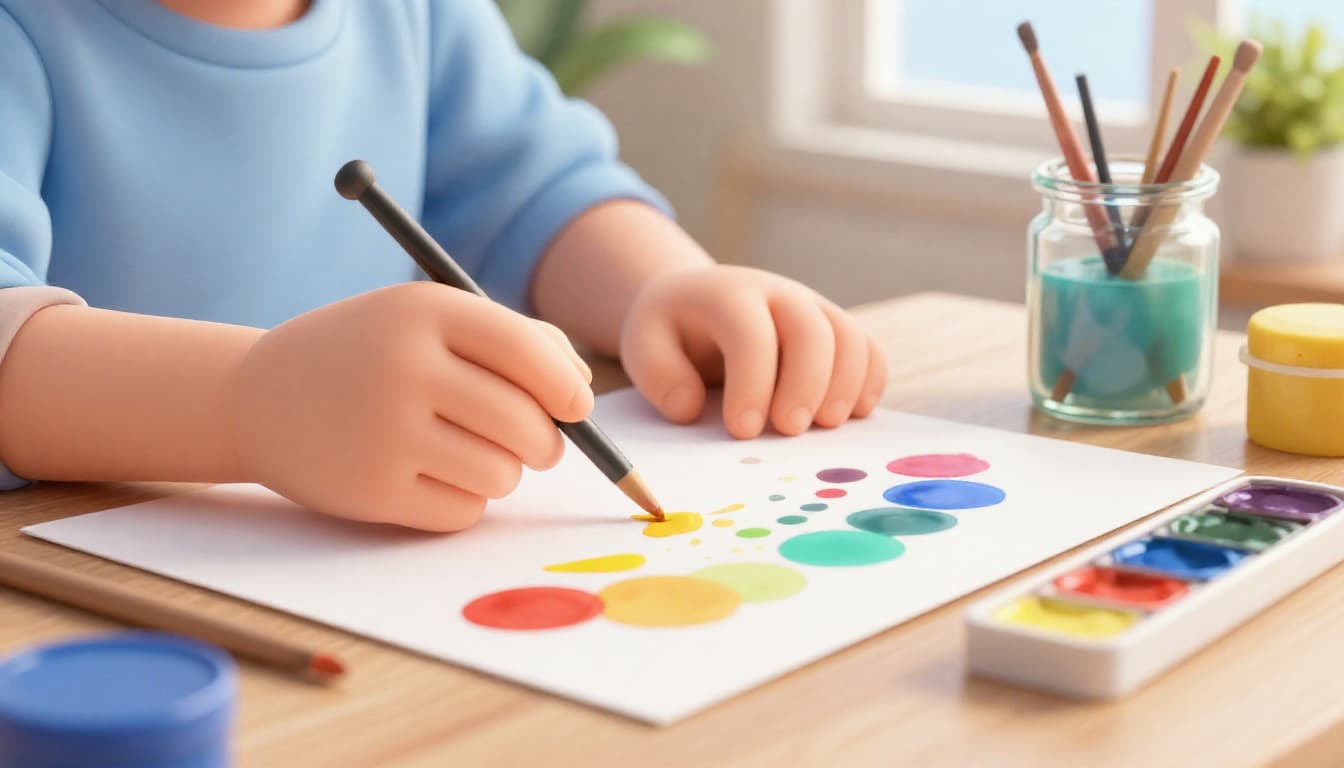
3. Color Mixing with Water
What you need: Six clear cups, water, red, yellow, and blue food coloring, pipettes or droppers
How to do it: Fill three cups with water and one primary color each. Set out three empty cups. Ask your child to use pipettes to combine two colors in each empty cup. The transparency of water makes color changes vivid and dramatic. Pipettes also build hand strength. This pairs naturally with process art ideas for toddlers where children explore color mixing through paint.
4. Plant Growing Observation
What you need: Clear plastic cups, potting soil, bean or sunflower seeds, water, a sunny window, paper for drawing observations
How to do it: Plant seeds, water lightly, and place in a sunny window. Each day, observe and draw what you see. Measure the sprout as it grows using paper clips or a piece of string. For a controlled experiment, plant two identical seeds — one in sunlight, one in a closet — and compare what happens.
5. Ice Melting Experiments
What you need: Several identical ice cubes, different conditions (salt, warm water, sunny spot, shady spot, towel, aluminum foil)
How to do it: Place an ice cube in each condition and predict which will melt fastest. Check every few minutes and discuss. This is one of the rare preschool activities that introduces experimental design in a genuinely age-appropriate way. Extend by freezing small toys inside ice blocks and giving your child warm water pipettes and salt to excavate them.
Technology Activities
At the preschool level, technology means using tools and understanding how things work — simple machines, gears, light, and magnification.
6. Simple Machines with Pulleys
What you need: A simple pulley (a thread spool, wire hanger, and string), a small basket, toys to lift
How to do it: Set up the pulley from a doorframe or play structure. Let your child load objects into the basket and pull the string to raise and lower the load. Children are astonished that pulling down makes the basket go up. Compare lifting by hand versus using the pulley, then look for simple machines around the house — a wheelbarrow, a doorknob, a seesaw.
7. Gear Toys Exploration
What you need: A set of gear building toys (interlocking gears that mount on a board)
How to do it: Let your child explore freely, then prompt: "What happens when you turn this gear? Which way does the next one turn?" Gears teach cause and effect, directionality, and problem-solving with immediate visual feedback. Look for gears in real life — a bicycle chain, an eggbeater, a music box.
8. Coding with Directional Cards
What you need: Homemade arrow cards (up, down, left, right), a small toy figure, a grid made from tape on the floor
How to do it: Place the toy at start and set a target destination. Ask your child to create a sequence of directional cards to move the toy to the target, then follow the directions together. When the toy ends up in the wrong place, debug — figure out which card was wrong. This is the essence of coding without a screen.
9. Light Table Explorations
What you need: A light pad (or a clear bin with string lights inside), translucent materials (colored acetate, pattern blocks, glass gems, colored water in small containers)
How to do it: Let your child explore freely, layering translucent objects on the light surface. Ask: "What happens when you put red on top of yellow?" Place natural objects like leaves on the table — the light reveals internal structures invisible under normal conditions. Pair with a magnifying glass for closer examination.
10. Magnifying Glass Nature Study
What you need: A kid-sized magnifying glass, a collection of natural objects (leaves, flowers, bark, feathers, stones, seeds)
How to do it: Show your child how to hold the magnifying glass close to objects and move it until the image focuses. Ask: "What do you see that you could not see before?" Children are consistently amazed by the tiny hairs on a leaf, the spiraling pattern inside a flower, the crystals in a rock. Take the magnifying glass outdoors to examine bark, soil, and insects in their natural context. This connects naturally to nature art projects for kids.
Engineering Activities
Engineering for preschoolers is building, testing, and improving — hands-on problem-solving with real materials.
11. Block Tower Challenges
What you need: A set of wooden unit blocks (or LEGO Duplo, Mega Bloks, or any building blocks)
How to do it: Start with "How tall can you build?" then introduce challenges: "As tall as your knee? Your waist? YOU?" After each collapse, discuss what happened and what to try differently. Every collapse is a lesson, every rebuild an experiment. Add constraints: build a tall tower using only five blocks, or build one that holds a stuffed animal on top. Our article on loose parts play ideas explores open-ended building with many more materials.
12. Bridge Building
What you need: Blocks, cardboard, popsicle sticks, tape, paper, two stacks of books as supports, a small toy car
How to do it: Set book stacks six inches apart and challenge your child to build a bridge between them that holds the car. Children discover that flat paper sags and fails, but the same paper folded into a fan shape holds weight — an intuitive introduction to structural engineering. Widen the gap or increase the weight to push their designs further.
13. Marble Run Building
What you need: A marble run set or homemade version using cardboard tubes, tape, and a wall or large cardboard sheet
How to do it: Tape tubes at various angles to a vertical surface. Drop a marble at the top and watch it travel down. Children discover that steeper angles mean faster marbles, turns must be angled correctly, and there is a lot of adjusting and re-taping before success — which is exactly the point.
14. Cup Stacking Engineering
What you need: Plastic cups (at least twenty), index cards as separators
How to do it: Stack cups with cards between layers and challenge your child to build the tallest structure possible. This is accessible to even young preschoolers because materials are lightweight and forgiving. The challenge scales naturally — a three-year-old might stack three layers while a five-year-old builds ten.
15. Cardboard Box Creations
What you need: Cardboard boxes, lots of tape, scissors (adult use), markers, paint, recycled materials
How to do it: Present a pile of boxes and a design challenge: "Build a house for your bear. A car you can sit in. A rocket ship." This is one of the purest engineering experiences — children must envision something, figure out how to build it, and solve problems along the way. For more ideas, see recycled materials art projects for kids.
Math Activities
Preschool math is about patterns, comparisons, sorting, measuring, and counting in the context of real play.
16. Pattern Making with Manipulatives
What you need: Pattern blocks or any colorful small objects (buttons, beads, counting bears)
How to do it: Start a pattern (red, blue, red, blue) and ask your child to continue it. Try complex patterns: red, red, blue, red, red, blue. Let your child create patterns for you to continue. Patterning is foundational algebraic thinking — the brain learns to predict regularity, which later supports understanding number sequences and mathematical functions.
17. Balance Scale Comparisons
What you need: A balance scale, objects to weigh (blocks, fruit, coins, stones, cotton balls)
How to do it: Compare pairs of objects — which is heavier? Then try balancing: "How many cotton balls equal one block?" Children develop intuitive understanding of weight and measurement. This links beautifully to the concrete math approach in Montessori math materials at home.
18. Measuring with Non-Standard Units
What you need: Uniform objects for measuring (paper clips, LEGO bricks, craft sticks, shoes), things to measure (books, tables, each other)
How to do it: Line paper clips along a book's edge and count. Measure something else with the same unit. Compare. Then switch to a different unit — children discover the object stays the same size but the number changes, a foundational measurement insight.
19. Sorting Collections
What you need: A mixed collection of small objects (buttons, shells, stones, beads, pasta, coins), a muffin tin for sorting
How to do it: Ask: "Can you put the ones that go together in the same group?" Do not define the criteria — let your child decide. They might sort by color, size, texture, or a category you would never think of. After one sort, ask: "Can you sort them a different way?" For a sensory twist, hide objects in a sensory bin first.
20. Shape Hunts
What you need: Shape cards (circle, square, triangle, rectangle, hexagon), a clipboard and crayon
How to do it: Walk around the house or neighborhood looking for each shape. A clock is a circle. A window is a rectangle. A stop sign is a hexagon. Tally each shape on the clipboard. Children who learn shapes only from worksheets often fail to recognize them in the world — shape hunts make geometry intuitive.
Tips for Doing STEM with Preschoolers
Process over product. The goal is the thinking and experimenting, not a specific result. A tower that falls seventeen times teaches more than one that stands on the first try.
Ask questions, do not give answers. "What do you think will happen?" "Why do you think that happened?" "What could you try differently?" Build the habit of investigation rather than the habit of waiting for answers.
Let them fail. Every failed tower and collapsed bridge is data. If we rescue them from failure, we rob them of the learning.
Follow their curiosity. Depth matters more than breadth. A child who explores ramps for a month develops richer understanding than one who touches twenty activities briefly. For a more structured approach with older children, see our guide to the best STEM curriculum for elementary homeschool.
Keep materials accessible. A low shelf with magnets, blocks, measuring cups, and a magnifying glass invites spontaneous investigation throughout the day.
Connecting STEM to Everyday Life
The most important STEM teaching happens in ordinary moments. Cooking is chemistry. Measuring ingredients is math. Weather is atmospheric science. Counting apples at the grocery store, estimating which bag is heavier, noticing shapes in architecture — all of it builds the mindset that the world is worth investigating.
STEM for preschoolers is not a curriculum. It is a way of looking at the world. When we give our children magnets and blocks and magnifying glasses and water and the freedom to explore, we are teaching them that they are the kind of people who can figure things out. Start with whatever you have on hand — a bowl of water, a pile of blocks, a magnet and a walk through the kitchen. The curiosity your child brings will do the rest.
Frequently Asked Questions
- What are good STEM activities for 3-year-olds?
- Great STEM activities for 3-year-olds include building with blocks, playing with ramps and balls, exploring magnets, mixing colors with water, sorting objects by size or color, and simple sink-or-float experiments. Keep it playful and hands-on.
- How do you teach STEM to preschoolers?
- Teach STEM to preschoolers through play and exploration, not worksheets. Ask open-ended questions like 'What do you think will happen?' and 'Why did that fall down?' Provide materials for building, experimenting, and creating, then follow their curiosity.
- What supplies do I need for preschool STEM?
- Most preschool STEM activities use everyday materials: blocks, ramps, balls, magnets, water, baking soda, vinegar, paper, tape, and recycled containers. A few helpful additions: a magnifying glass, a simple balance scale, and a magnet kit.
Enjoying this article?
Get more ideas like this delivered to your inbox every week.