15 Hands-On Math Games and Activities for Homeschool (By Grade Level)
15 hands-on math games and activities organized by grade level — from counting with manipulatives to fraction cooking projects — that make math concrete and fun.
By The Slow Childhood
The best hands-on math activities for homeschool use physical objects and real-world connections to make abstract concepts concrete. Research consistently shows that children who learn math through manipulatives, games, and hands-on exploration develop stronger number sense and retain concepts longer than those who rely solely on worksheets. Below, we share 15 of our favorite math activities organized by grade level, from simple counting games for preschoolers to fraction cooking projects and pre-algebra challenges for upper elementary students.
Why Hands-On Math Matters
If your child groans when you pull out the math workbook, you're not alone. Math is the subject most likely to cause tears in a homeschool — and it doesn't have to be that way.
The problem isn't usually the child. It's the approach. Young children's brains aren't wired for abstract symbols on a page. They need to touch, move, build, and play with mathematical concepts before those concepts can live as numbers on paper. This is the concrete-before-abstract principle, and it's the foundation of every strong math curriculum.
Hands-on math activities aren't a substitute for your curriculum — they're the secret ingredient that makes your curriculum work. Use them to introduce new concepts, reinforce struggling areas, or simply bring joy back into your math time.
Essential Manipulatives to Have on Hand
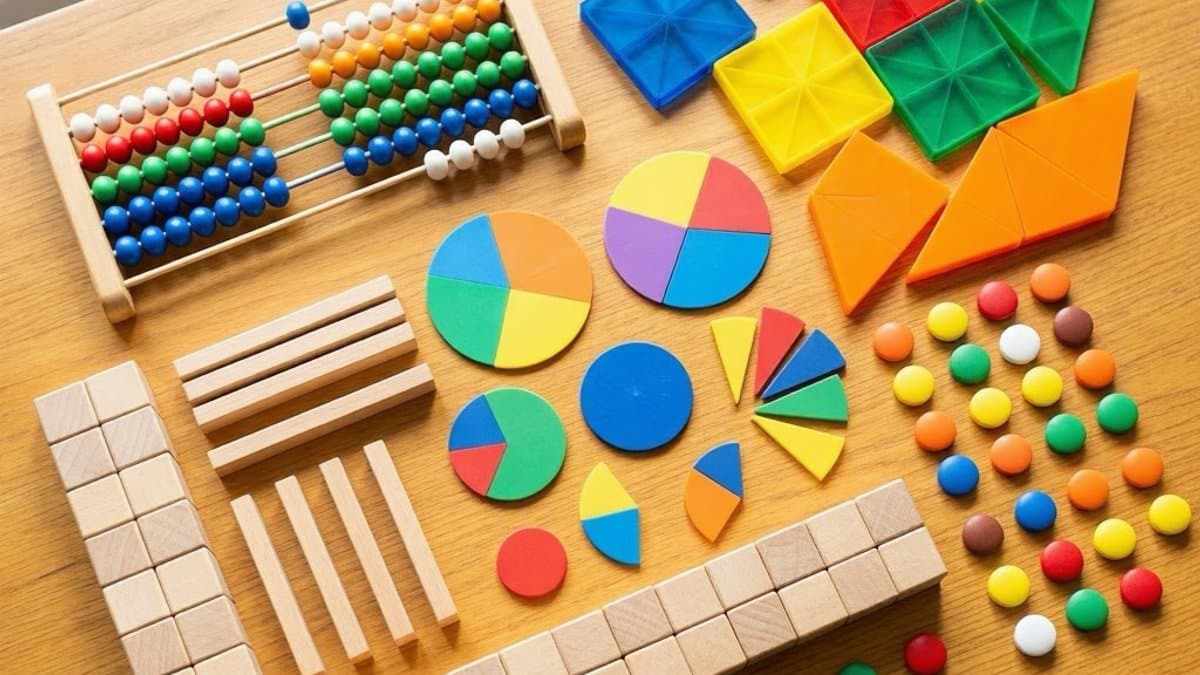
Before we dive into activities, here's what we recommend keeping in your math toolkit:
- Cuisenaire rods — Colored rods of different lengths that represent numbers 1-10
- Base-ten blocks — Units, rods, flats, and cubes for place value
- Fraction tiles or circles — For visualizing parts and wholes
- Standard dice and polyhedral dice — For countless games
- A hundreds chart — Laminated so you can write on it
- Coins and play money — For money and decimal concepts
- A simple balance scale — For measurement and equality concepts
- Dried beans or glass gems — For counting, grouping, and multiplication arrays
Total investment: about $40-60 for a set that will last years.
Pre-K and Kindergarten Activities (Ages 4-6)
1. The Estimation Jar
Fill a clear jar with objects — marbles, acorns, dried pasta, cotton balls — and ask your child to estimate how many are inside. Then count together. Change the objects weekly.
What it teaches: Number sense, estimation, one-to-one correspondence, counting Materials: A clear jar and whatever small objects you have Time: 5-10 minutes
This deceptively simple activity builds one of the most important early math skills: the ability to look at a quantity and make a reasonable guess. Start with small numbers (5-15 objects) and gradually increase as your child's sense develops.
2. Nature Walk Counting and Sorting
Take a basket outdoors and collect natural objects — pinecones, rocks, leaves, sticks, acorns. Back inside, sort them by attribute (size, color, type, texture), count groups, and compare quantities. Which group has more? Fewer? How many altogether?
What it teaches: Sorting, classification, counting, comparison, early addition Materials: A basket and whatever nature provides Time: 20-30 minutes (walk included)
This is living math at its finest. You're doing Charlotte Mason-style nature study and math simultaneously, and your child doesn't even realize they're doing "school."
3. Cuisenaire Rod Free Play and Trains
Before using Cuisenaire rods for formal instruction, let children play freely. They'll naturally build stairs, patterns, and "trains" (lines of rods placed end to end). Then introduce a challenge: "Can you make a train exactly as long as the orange rod using only white rods? How about using red rods?"
What it teaches: Number relationships, equivalence, early addition and subtraction Materials: A set of Cuisenaire rods ($15-25) Time: 15-20 minutes
This is the entry point for one of the most powerful manipulatives in math education. Once your child is comfortable playing, these rods can teach addition, subtraction, multiplication, fractions, and even basic algebra.
Early Elementary Activities (Ages 6-8, Grades 1-2)
4. Grocery Store Math
Give your child a small budget ($5-10) at the grocery store and let them choose items while keeping a running total. For younger children, round to whole dollars. For older children, work with exact cents.
What it teaches: Addition, subtraction, money, estimation, real-world application Materials: A grocery store and a small budget Time: Variable (works during regular shopping trips)
There is no worksheet in the world that teaches money sense as effectively as handling real money in a real store. Start with simple tasks ("Pick out fruit for the family, but stay under $5") and gradually increase complexity.
5. Roll and Cover Place Value
Create a simple game board with numbers 10-99. Roll two dice — one represents tens, the other represents ones. Build the number with base-ten blocks, then cover it on the board. First to cover five in a row wins.
What it teaches: Place value, number recognition, number composition Materials: Two dice (different colors), base-ten blocks, a printed hundreds chart Time: 15-20 minutes
Place value is the most important concept in early math, and it's the one most commonly rushed. This game gives children repeated, low-pressure practice building and recognizing two-digit numbers.
6. Sum Swamp Board Game
Sum Swamp by Learning Resources is a simple board game where players add and subtract their way through a swamp. It's not flashy, but it provides exactly the kind of repeated, low-stakes practice that builds addition and subtraction fluency.
What it teaches: Addition and subtraction facts within 12 Materials: Sum Swamp game ($15-20) Time: 20-30 minutes per game
We keep this one in our regular game rotation. The competitive element motivates practice, and the swamp theme keeps younger children engaged. For a more advanced alternative, try Math Dice Jr. by ThinkFun.
7. Measurement Cooking Day
Pick a simple recipe and let your child handle all the measuring. Double the recipe (multiplication practice) or halve it (early fractions). Discuss which cup is bigger, how many quarter-cups make a whole cup, and why accurate measurement matters.
What it teaches: Measurement, fractions, multiplication, practical math, following sequential instructions Materials: A recipe, measuring cups and spoons, ingredients Time: 30-60 minutes
Cooking is the ultimate hands-on math activity because the feedback is immediate and delicious. If you measure wrong, the cookies taste wrong — that's a more powerful lesson than any red mark on a worksheet.
Upper Elementary Activities (Ages 8-10, Grades 3-4)
8. Multiplication Arrays With Graph Paper
Have your child draw arrays on graph paper to visualize multiplication facts. A 3x4 array shows why 3 times 4 equals 12. Color-code the arrays and cut them out to physically compare: is 3x4 the same size as 4x3? (Hello, commutative property.)
What it teaches: Multiplication concepts, commutative property, area, visual representation Materials: Graph paper, colored pencils, scissors Time: 15-20 minutes
Many children memorize multiplication tables without understanding what multiplication means. Arrays fix this. Once your child understands that 3x4 means "three groups of four" or "a rectangle that's 3 by 4," the memorization follows naturally.
9. Fraction Pizza Party
Use paper plates divided into sections (or actual pizza dough, if you're ambitious) to explore fractions. Cut a plate into halves, another into thirds, another into fourths. Compare: is 1/2 bigger or smaller than 1/3? Why? Can you make 3/4 using two different combinations of smaller pieces?
What it teaches: Fraction concepts, equivalent fractions, comparison, addition of fractions Materials: Paper plates, markers, scissors (or real pizza ingredients) Time: 20-30 minutes
Fractions are the great stumbling block of elementary math. Children who learn fractions only with numbers on paper often develop deep misconceptions (like thinking 1/3 is bigger than 1/2 because 3 is bigger than 2). Physical fraction models prevent these errors.
10. Prime Climb Board Game
Prime Climb by Math for Love is a beautiful, strategy-rich board game where players multiply and divide their way around a colorful board. Each number is color-coded by its prime factorization, so children absorb number theory concepts through play.
What it teaches: Multiplication, division, prime numbers, factors, strategic thinking Materials: Prime Climb game ($25-30) Time: 30-45 minutes per game
This is the best math game we've found for upper elementary. It's genuinely fun — adults enjoy it too — and the learning happens almost invisibly. The color-coding system is brilliant: children start to see the structure of numbers in a way that worksheets never reveal.
11. Living Math Book Club
Read a living math book together — titles like The Number Devil, Sir Cumference and the First Round Table, Mathematicians Are People, Too, or Life of Fred — and discuss the mathematical concepts woven into the stories.
What it teaches: Mathematical thinking, history of math, problem-solving approaches, math as a human endeavor Materials: Living math books (library or $8-15 each) Time: 20-30 minutes per reading session
Living books transform math from a set of procedures into a story of human discovery. Pair these with your regular math curriculum for a richer mathematical education.
Late Elementary and Middle School Activities (Ages 10-13, Grades 5-7)
12. Stock Market Simulation
Give your child a fictional $1,000 and let them "invest" in real stocks. Track prices weekly using a simple spreadsheet or a notebook. Calculate percentage gains and losses, compare different strategies, and discuss what makes companies valuable.
What it teaches: Percentages, decimals, positive and negative numbers, data analysis, financial literacy Materials: A notebook or spreadsheet, access to stock price information Time: 30 minutes to set up; 15 minutes per week to update
This is one of those activities that starts as a math exercise and becomes a genuine interest. Children who track stocks naturally become invested (pun intended) in understanding percentages, decimals, and data analysis.
13. Geometric Construction With Compass and Straightedge
Teach your child to construct perfect geometric shapes using only a compass and straightedge — the way the ancient Greeks did it. Start with a perfect circle, then an equilateral triangle, then a hexagon, then a perpendicular bisector.
What it teaches: Geometry, precision, the properties of shapes, mathematical reasoning, history of mathematics Materials: A compass, a straightedge (ruler without measurements), paper Time: 20-30 minutes per construction
There's something deeply satisfying about constructing a perfect hexagon from first principles. This activity connects math to its historical roots and develops the precise, logical thinking that algebra will demand later. It also pairs naturally with an art curriculum — geometric constructions are the foundation of many artistic traditions.
14. Build a Scale Model
Choose something to model — your house, your bedroom, your neighborhood, a historical building you're studying — and build a scale model. This requires measuring the real thing, choosing a scale factor, calculating scaled dimensions, and constructing accurately.
What it teaches: Ratios, proportional reasoning, measurement, spatial thinking, multiplication and division of decimals Materials: Measuring tape, cardboard or foam board, scissors, glue, ruler Time: Several hours over multiple days (makes an excellent project)
Scale models integrate nearly every math concept your child has learned into a single, tangible project. They also connect beautifully to history, geography, and science studies.
15. Math Journaling
Provide a blank journal and a weekly math prompt. Prompts might include: "Explain how to divide fractions to someone who has never done it," "Draw three different shapes that all have the same area," or "Write about a time you used math outside of school this week."
What it teaches: Mathematical communication, conceptual understanding, metacognition, writing across the curriculum Materials: A blank journal and a list of prompts Time: 15-20 minutes per entry
Math journaling is where math and writing intersect. When children explain mathematical thinking in words, they deepen their own understanding and develop the communication skills they'll need in higher math. This is an excellent bridge activity for children who love writing but resist math, or vice versa.
How to Incorporate Games Into Your Math Routine
The best approach isn't to replace your curriculum with games — it's to weave them in strategically:
- Use games to introduce new concepts. Before teaching multiplication formally, play with arrays and Cuisenaire rods. The concrete experience gives your child a mental framework for the abstract instruction that follows.
- Use games for review and fluency. After your child learns addition facts, play Sum Swamp or Math Dice to build speed and automaticity.
- Designate one "game day" per week. Replace your regular math lesson with a math game day every Friday. This gives everyone something to look forward to and ensures hands-on activities don't get squeezed out.
- Keep a math game shelf. Have 3-5 math games accessible for free time. Children often choose to play math games voluntarily when the games are genuinely fun.
Our Favorite Math Game Shopping List
If you're building a math game collection from scratch, here's where we'd start:
| Game | Age Range | Concepts | Price |
|---|---|---|---|
| Sum Swamp | 5-7 | Addition, subtraction | $15 |
| Math Dice Jr. | 6-8 | Addition, mental math | $8 |
| Sleeping Queens | 6-10 | Addition, number recognition | $12 |
| Prime Climb | 8-12 | Multiplication, primes, factors | $25 |
| Zeus on the Loose | 8-12 | Addition, multiples | $12 |
| Proof! | 9+ | All four operations | $15 |
The Bigger Picture
Hands-on math isn't just about making math "fun" — though it does that too. It's about building the deep, flexible understanding that carries children through algebra, geometry, and beyond.
Children who learn math through manipulatives and games understand why mathematical procedures work, not just how to perform them. That conceptual foundation is what separates students who thrive in higher math from those who hit a wall.
So put down the flashcards, pick up the Cuisenaire rods, and play. Your child's mathematical future will be stronger for it.
Frequently Asked Questions
- What are the best hands-on math activities for homeschool?
- The best hands-on math activities use physical manipulatives to make abstract concepts concrete. Top options include Cuisenaire rods for number relationships, base-ten blocks for place value, fraction tiles for pizza or cooking projects, and board games like Sum Swamp and Prime Climb for practice. The best activity depends on your child's grade level and which concept you're teaching.
- How do I make math fun for my homeschooler?
- Make math fun by connecting it to real life — cooking (fractions, measurement), shopping (money, percentages), building (geometry, measurement), and games (strategy, logic). Use physical manipulatives instead of worksheets, play math board games, and take math outdoors with nature-based counting and pattern activities. The key is making math something children do, not just something they watch or read about.
- What math manipulatives should I buy for homeschool?
- Start with these essentials: Cuisenaire rods, base-ten blocks, a set of dice (standard and polyhedral), a hundreds chart, fraction tiles or circles, and a simple abacus for younger children. You can supplement with household items like dried beans, LEGO bricks, coins, and a kitchen scale. Most families spend $30-60 on a solid manipulative set.
- Can math games replace a formal math curriculum?
- Math games are a powerful supplement but generally shouldn't replace a formal curriculum entirely. Games excel at building number sense, fluency, and positive associations with math, but most children also need systematic instruction in new concepts. Many families use a curriculum like RightStart Math or Math-U-See as their spine and add games for review and enrichment.
Enjoying this article?
Get more ideas like this delivered to your inbox every week.